JP e3s organizes scientific conferences and thematic workshops (open to the broader public or to its members only) to discuss about the most crucial topics related to the clean energy transition and the impacts they could have on the society.
May 2026 - Expert Round Table on Social impacts of hydrogen technologies and application
On 8 May 2026, the EERA Joint Programme on clean Energy tranSition for Sustainable Society (JP e3s), in collaboration with Ecoinnovazione, organised an expert round table in Brussels on the social impacts of hydrogen technologies and applications.
The event marked the first step of a broader research pathway aimed at identifying, categorising and prioritising social impacts across the hydrogen sector, as well as assessing how these impacts can be meaningfully defined and measured. Through moderated discussions, participants explored the social implications of hydrogen technologies across the value chain, distinguishing between technology-specific and system-level effects, and reflecting on the territorial dimensions of hydrogen deployment, including regional inequalities and just transition concerns.
The outcomes of the round table will inform the next stages of the process: an EU-wide survey and a participatory workshop involving industry, policymakers, civil society and local communities, ultimately contributing to the development of a position paper in the first half of 2027.
September 2025 - Special Session on Rethinking energy demand reduction: beyond the efficiency mantra
JP e3s organized a special session titled "Rethinking energy demand reduction: beyond the efficiency mantra" during the ESA RN12 'Environment and Society’ mid-term and 'Energy and Society' network 7th joint conference which took place in Kaunas (Lithuania) on 24-25 September 2026.
May 2025 - Joint Workshop on Smart Operations of Energy Storage Technologies in Future Energy Markets
EERA JPs Energy Storage (ES), clean Energy tranSition for Sustainable Society (e3s), Concentrating Solar Power (CSP), and Digitalization for Energy (DfE) jointly organised this workshop, which took place on 13–14 May 2025 at the Universidad Politécnica de Madrid, Spain.
The workshop focused on the role of energy storage technologies in modern energy systems, particularly their contribution to the integration of renewable energy sources and the improvement of overall system reliability. Discussions highlighted how these technologies allow excess energy to be captured and made available when most needed, thereby improving system efficiency and supporting the transition towards a more sustainable energy future.
At the same time, the workshop addressed the need to optimise the operation of energy storage systems in order to minimise inefficiencies arising from factors such as energy conversion losses, self-discharge rates, and operating strategies. Participants discussed the use of advanced algorithms and predictive analytics to manage charge and discharge cycles more efficiently, ensuring that energy is stored and released at the most favourable times.
The workshop also emphasised the importance of accurate modelling of energy storage technologies in current energy system models. Such modelling is essential to better integrate renewables by representing how storage systems respond to fluctuations in energy supply and demand. This, in turn, supports informed decision-making by energy system operators, helps ensure reliability and stability, and enables the assessment of different operational strategies and their impact on efficiency and costs.
READ THE PROCEEDINGS HERE
September 2024 - Joint Workshop on Revamping Hydropower Research
The "Revamping Hydropower Research" workshop, held in Brussels in September 2024, was organized by EERA's Joint Programmes on Hydropower, Clean Energy Transition for Sustainable Society (E3S), and Digitalisation for Energy. From JP e3s side it was organized in the framework of Sub-Programme 4. The event brought together experts to explore how hydropower, digitalisation, and grid integration can enhance sustainable energy systems.
Key discussions highlighted hydropower’s role in renewable integration, environmental impacts, and public acceptance. Experts emphasized digitalisation’s potential, including AI and digital twins, to improve efficiency and sustainability.
The full proceedings are available in IOP Conference Series: Earth and Environmental Science, Volume 1442, offering insights into hydropower’s evolving role in the clean energy transition.
READ THE PROCEEDINGS HERE
September 2024 - Workshop on Cultural Engagement Through Digitalization as a Driver of the Clean Energy Transition
October 2023 - Conference on energy demand reduction
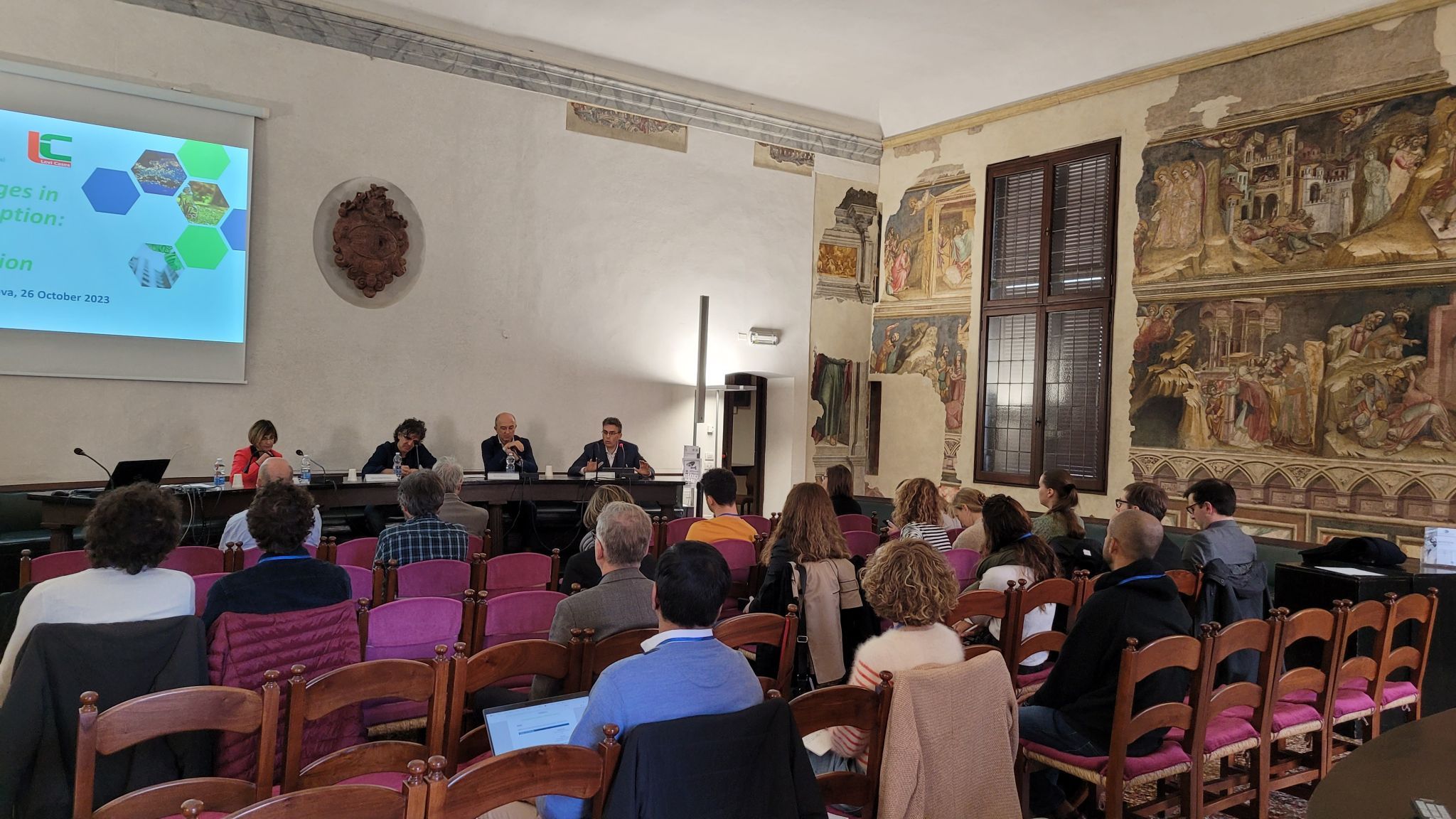
On 26th October 2023 the JP e3s, under coordination of Sub-Programme 1, organized the conference "Fostering Changes in energy consuption: a pathway to demand reduction" in Padova (Italy). The event represented a starting point to stimulate a scientific and interdisciplinary discussion about energy demand reduction, that will culminate in the writing and publication of a White Paper on the topic in summer 2024. The Conference was structured in 3 main sessions, corresponding to three different, but complementary, ways of addressing energy demand reduction. Here below are the presentations of each session:
Keynote speeches:
-
Adel El Gammal (EERA) "Net Zero Growth by 2050"
-
Yves Marignac (négaWatt group) "The concept and role of sufficiency in fostering a sustainable and just energy transition"
-
Benjamin Sovacool (Boston University, University of Sussex, Aarhus University) "The sociotechnical dynamics and equity dimensions of energy efficiency, smart meters and smart homes" (presentation not available yet)
Behavioural change:
-
Omkar S. Patange (IIASA) "Role of population heterogeneities in energy consumption behaviour"
-
Daniele Stampatori (EU) "The behavioural dimension of energy customers: A framework to deal with barriers to customer engagement"
-
Gianluca Carraro (UNIPD) "Energy Communities: what is the impact of members’ habits on fossil fuel consumption?"
-
Tiina Koljonen (VTT) "Save energy - make it a habit"
-
Stine Fleischer Myhre (IFE) "Investigation of energy behaviour and behavioural change in the Norwegian energy system based on smart metering data"
-
Ezilda Costanzo (ENEA) "Cultural audience engagement for the clean energy transition: opportunities and evidence"
Energy Efficiency:
-
Kristina Haaskjold (IFE) "The role of building mass upgrade in the energy system transition - A Norwegian case study"
-
Ivett Flores (TUB) "A value-based framework from Building Stock Model to Reftrofit Model"
-
Marina Bertolini (UNIPD) "Renewable energy communities, digitalization and information"
-
Herbert Zondag (TNO) "The Role and Impact of Energy Efficiency in the Decarbonization of Industry" (presentation not available)
-
Luciano DE Tommasi (IERC) "Energy efficiency in the commercial rented sector and verification of rebound effect after PV system installation in shopping center in Spain"
-
Maria Beatrice Andreucci (UNIROMA1) "Promoting reduction of energy demand and climate adaptation through integrated simulation tools and indicators: A recent case study"
-
Giovanna Cavazzini (UNIPD) "The need of flexibility in the hydropower sector: an European overview"
Energy Sufficiency:
-
Vito Di Noto (UNIPD) "Production, distribution and applications of H2 in a clean energy system" (presentation not available)
-
Tareen Muhammad Umair (ULiège) "A low-demand energy scenario for Europe modelled in PyPSA-EUR"
-
Romain Mauger (CIIAE) "For an Energy Sufficiency First Principle in EU energy law"
June 2023 - Joint Workshop on non-technical factors for Energy Storage deployment
On 16th June 2023 the EERA Joint Programme e3s and Joint Programme Energy Storage co-organized the workshop "Energy for the future: exploring non-technical factors for Energy Storage deployment". The event contributed to build a multidisciplinary bridge through the promotion of a concrete dialogue and practical exchange of knowledge, information and perspectives among the members of the two EERA Joint Programmes Energy Storage and e3s-clean Energy tranSition for Sustainable Society. In addition to a comprehensive, although synthetic, reciprocal update about the state of the art on the most promising energy storage (ES) technologies, with a specific focus on hydrogen and its storage potential, and the most widely diffused social, legal and economic widely recognized factors affecting RES technologies development at the different scales of the energy system (EU, national, regional and local), the participants have been engaged in a structured discussion aimed at identifying the main challenges and explore possible ES solutions to be diffused in the EU energy system.
May 2023 - JP e3s Scientific Conference
On 24th May 2023 the JP e3s members met in Helsiki to discuss about the topics addressed by each Sub-Programme and define/identify future related activities. The main results of the scientific conference have been collected in a document that can be downloaded and consulted here. Moreover, you can find each SPs presentation here below: